
A living body of work
Tobias van Schneider's philosophical lens
In a world of “home — about — work” websites, Smells Like Copy looks for the non-linear. This blog is a series of curated and deconstructed website narratives that break the mold. It’s interested in the cogs and wheels, experiential bits that are woven in to make something stand out. This season, I’m putting my butcher’s on creative portfolios. Every issue is free — enjoy.
Today’s deep dive: Tobias van Schneider, creative community icon.
Unlike many peers and clients, Mr. van Schneider’s knack for personal branding doesn’t end with timeless visuals. His work - for clients, for fun, for himself - branches far outside of the usual portfolio work + slice of life content.
He established himself as a thought leader early on in the game by combining state-of-the-art visual translations with fresh articulations on the craft and mindset.
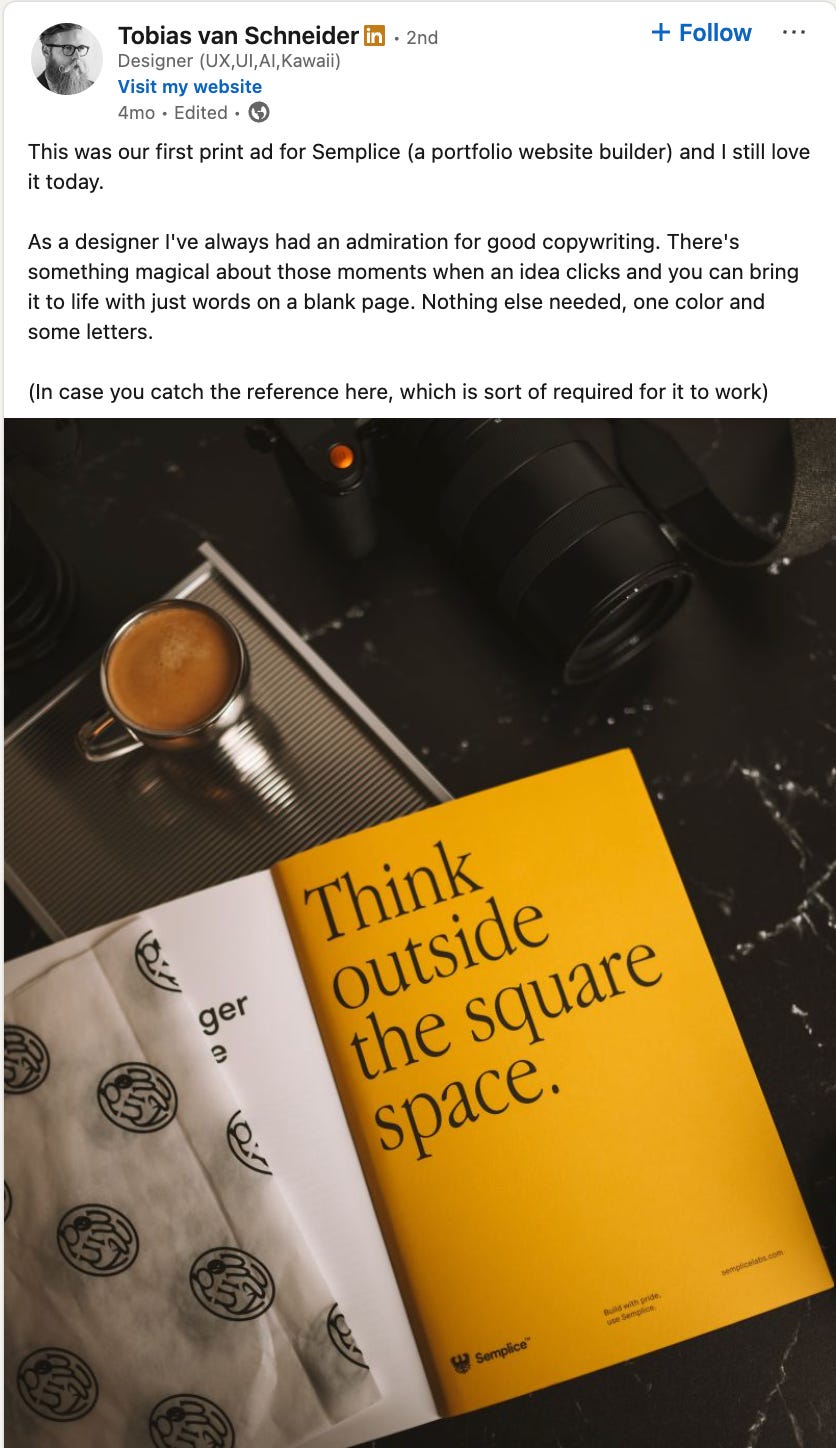
Mr. van Schneider says he “likes brands with a point of view.” He clearly practices what he preaches. From the leading lines on his website down to the subtitles and captions, the lens through which he views the facts is made known.
His portfolio is a masterclass in pacing a mountain of content. But first -
The headline
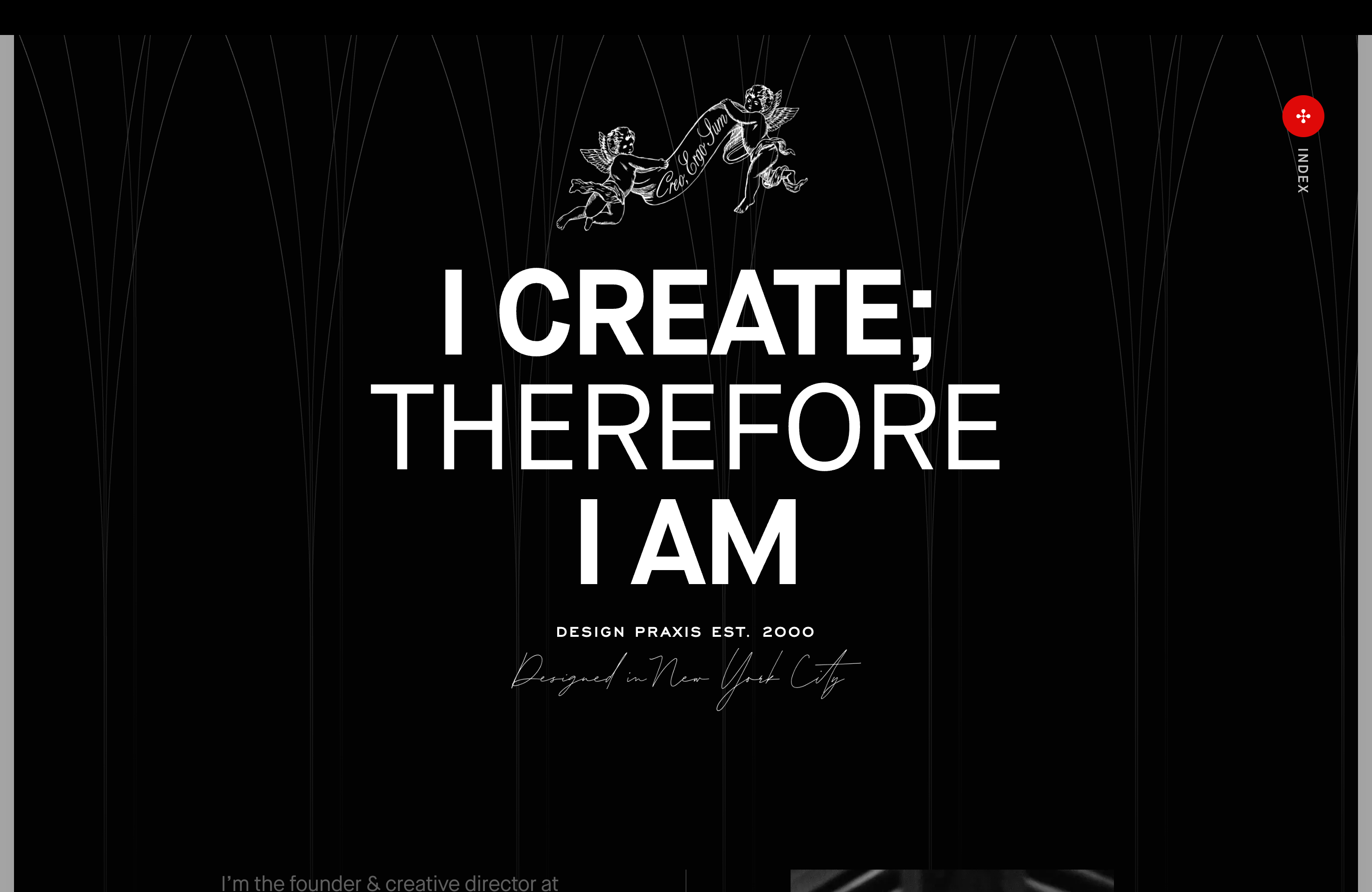
Praxis over theory. Learning by doing. Living the creative, not just putting it on for work. The tagline sets the stage and heightens our expectations. Immediately we imagine something far more than a classic creative portfolio.
The headline is a twist on a well-known classic. Remixing Voltaire’s words is a bold move that absolutely must be followed up with a world-class design niveau.
Unsurprisingly, Dan Nelken calls this catchy technique a ‘twist on a popular phrase.’ (Shout out to Dan Nelken and his wonderful teaching style!) More on how to replicate it downstairs. But for starters, you don’t have to be Voltaire to stand out. If you’re not on that level, that’s going to land awkwardly. Find a well known quote or idiom that reflects your actual brand avatar - be it Mr. Rogers or Mae West -, and play around!
Next:
The about
Tobias does not say hi. He does not start with his name..
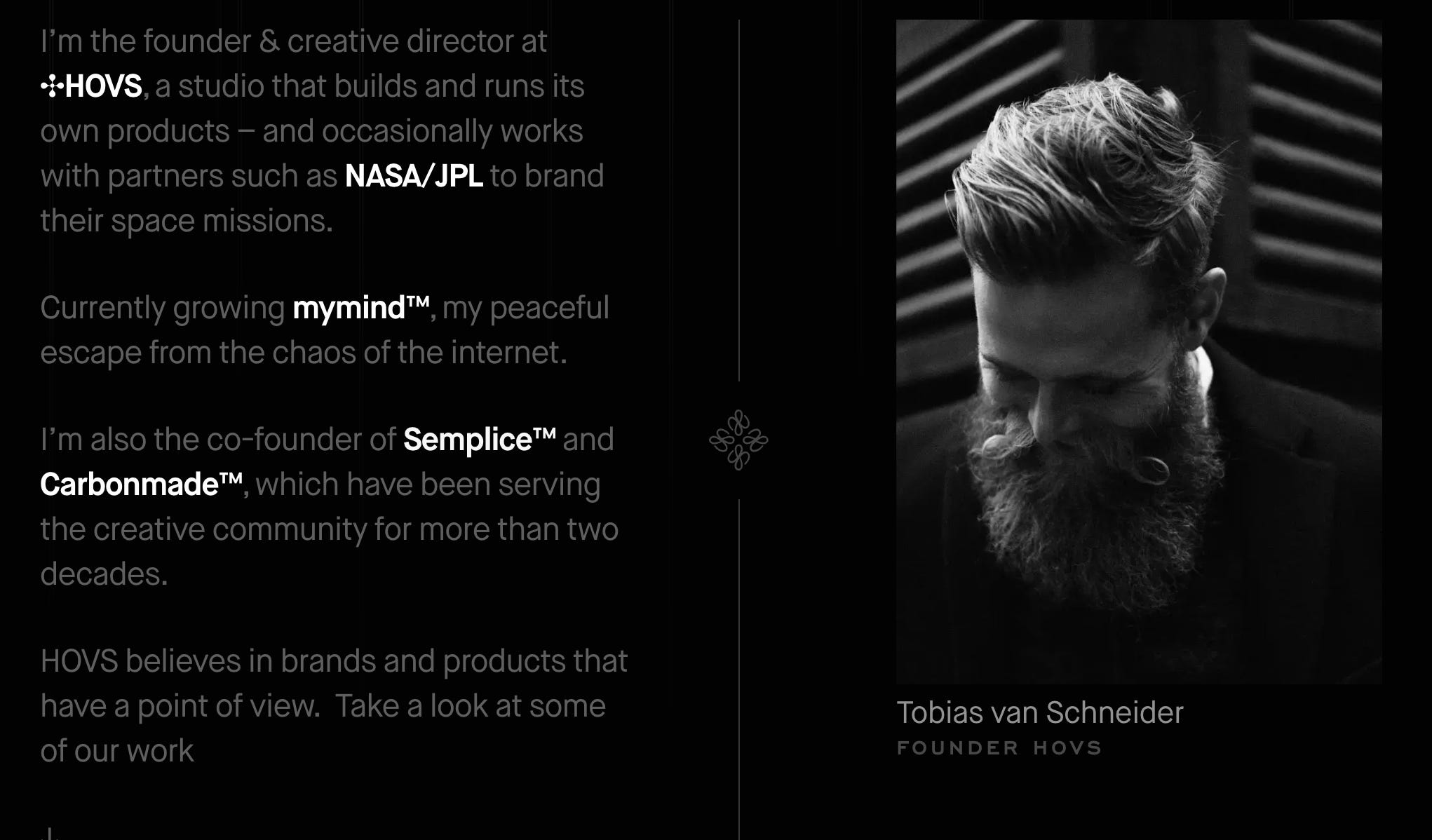
Instead of setting the tone to something more conversational, the red thread is the work itself.
The question answered isn’t “who am I, what do I do?” But rather, what is the brand’s throughline, and it’s personality?
If you’re not a personality brand, or even if you are, ask yourself what you’re most remembered for. Is it the work? A unique service style? You may find the answer to this question in your testimonials. In the first words that someone utters to you after debriefing, delivering, invoicing. Pay attention to them. Find some North Stars.
An alternative: be what everyone is not about
Another way to decide what your red thread (or some kind of branding ‘blue ocean’) is is to look around your competition and think about what you’re doing, that they’re not doing. Are they serious? Bring your joy. Saturating podcasts? Stand tall on the long-form written content you love. Printing tote bags? Brand your own cigarettes or cheese or other oral fixation of choice.
Back to the house of van Schneider, and:
The CTA
After a touch of name-dropping (NASA/JPL), a nod to product development, and a teaser on life philosophy elegantly delivered in a few sentences, the ball is in our court. After this bio I feel less like I was stepping into a portfolio and more like I was entering a retrospective.
The captions / case studies
Breaking with conformity, Schneider has chosen to add (way) more than one line teasers. In fact, his entire case studies are all presented on the home page - complete with carousels.
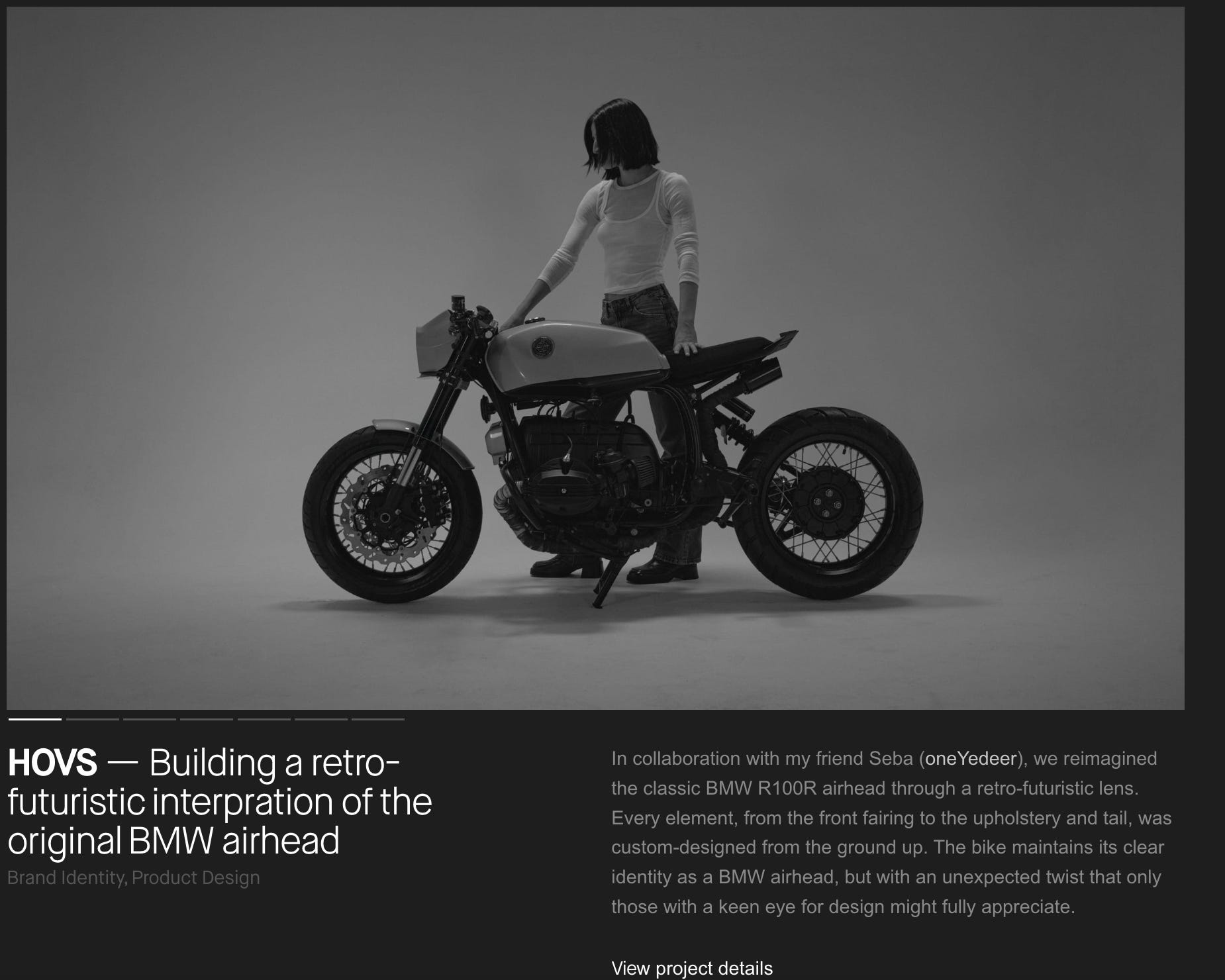
Once you click through to the links on some of them, the stories only grow. We find that this designer is not shy taking up the proverbial microphone. (This copywriter rejoices. )
But back to the homepage. As for the captions themselves, sometimes they tell the story, sometimes they present the facts, and sometimes they take a deep dive into the style elements. Where Schneider shines is that there’s no one formula for everything. He’s mixed up the descriptions with a different voice. Instead of throwing us off with a lack of consistency, it gains authenticity with its human cadence. Also learned a lot cause the process isn’t crammed into three lines and a soundbyte.
The random artifacts
Other whimsical wonders of this website are the brief interspersals of random side projects, photos, and more from Schneider. In a kind of reverse psychology, we find ourselves pulled into the coolness of the projects by the detachment with which they’re shared.
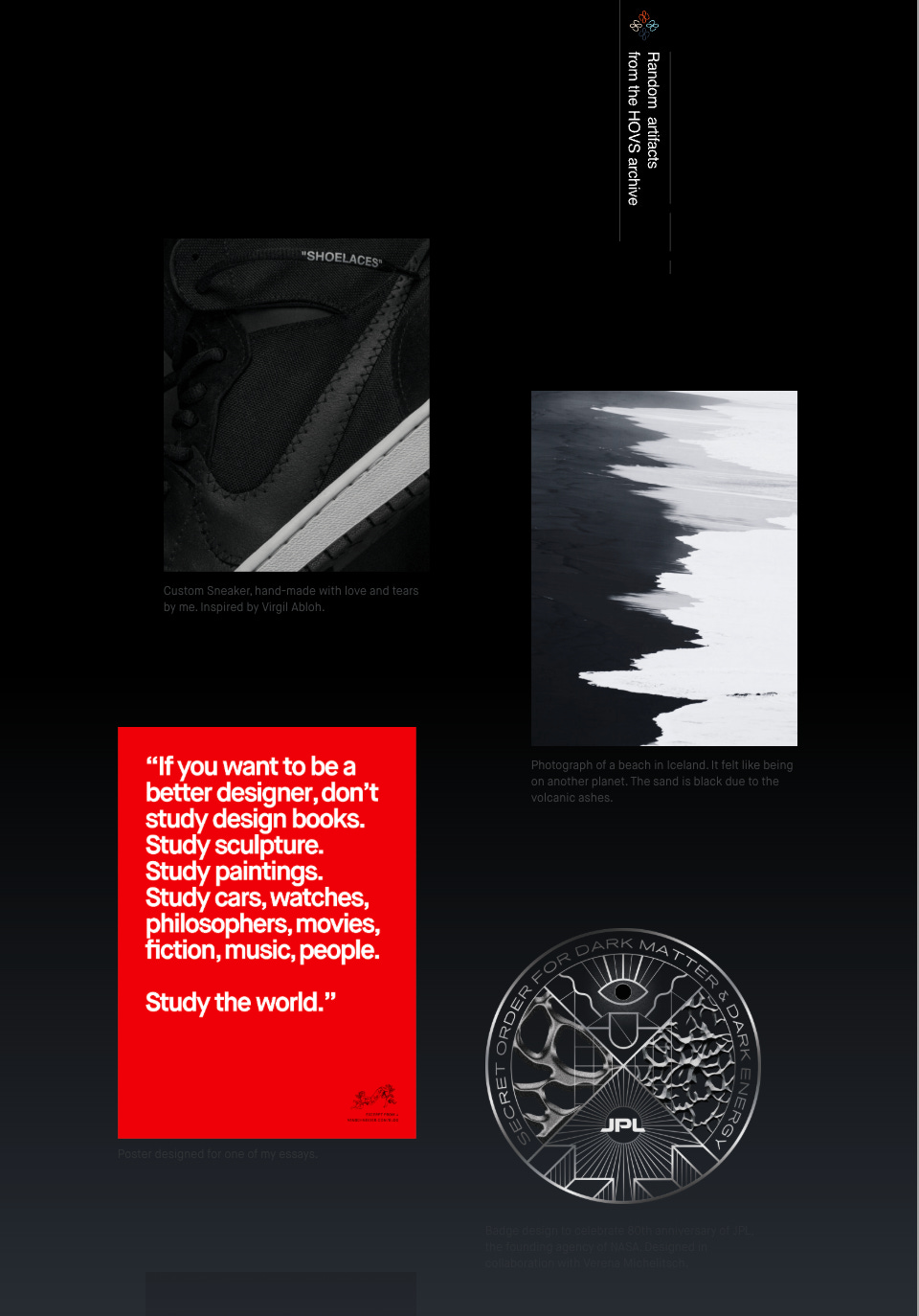
Rather than experiencing it as a kind of distraction, these sections break up the monotony of case study after case study, keeping us on the page for longer.
Whether it’s design or copy, your goal is always to keep your reader sticking around for one more line, one more scroll, a few more seconds. And the next and the next. Random artifacts are a well-designed way of one way to make that happen.
The farewell
Schneider hasn’t built a portfolio, he has built a house of creativity. From the nuts and bolts, to the interior, furnishings, and chotzkes - every piece in the domain tell us more about him through his work - be it writing work, design, concepting, or philosophizing.
In a world where LinkedIn algorithms encourage us to file ourselves down to a strict narrow lane, we can take inspiration from this literal body of work. Is he insanely prolific? Looks like. But he also shows us that everything can be creative. And that repetition is key to cementing a brand. There are plenty of gold nuggets I’ve seen on a recurring basis from his universe.
Packing a creative life into one narrative is the stuff of retrospectives. But if you’re playing the long game - with personal branding or potential career pivots - a big vision can keep everyone on the same page.
Exercises for expressing your philosophy:
A good friend of mine and excellent coach, The Gunjan of MutedSpace, shared this incredible video with me. It’s a TEDx talk so watching it is shorter than me explaining it. But I found it very helpful in honing in on an authentic brand essence.
As for the Dan Nelken headline tactic, it’s kind of a no brainer.
Take a visit to tinyquotes or tinybuddha and write down your favorites. Do the same at Spruce or in the idioms tab on Free Dictionary.
Do yourself a favor and avoid the usual suspects. Start playing around with buzzwords from your introduction above, different values words, active verbs. Make a list of no less than 40 alternatives. Don’t cheat! Writing is a practice.
And the 40th one may be the best of all.
That’s all for today, thank you for stopping by!